





When Is Orthophthalic Resin Good Enough: Application Limits and Selection Criteria

Orthophthalic resin works well for indoor jobs that are not corrosive and only need moderate strength, where cost matters most. This post shows exactly where that limit is and how to test a specific job against it.
Budget pressure pushes buyers toward the cheapest grade that will pass. Using a grade that is too low leads to cracking, blistering, or early failure. Most resin decisions go wrong in the gap between those two forces.
A short checklist follows, along with a fair comparison of orthophthalic, isophthalic, and vinyl ester options. Readers can then match a grade to the job instead of guessing.
Key Takeaways
Orthophthalic resin works best for indoor jobs that have no harsh chemicals and only moderate loads.
Before you pick this resin, check the service environment, the load type, and the temperature range.
Don't use orthophthalic resin where it will touch water all the time, face strong chemicals, or take heavy dynamic stress.
Switch to isophthalic, DCPD-modified, or vinyl ester when the job goes past these limits.
Check the fire rating and storage conditions to make sure the resin works well.
Where Orthophthalic Resin Fits Best

Good-Fit Applications
Orthophthalic resin works for a clear set of jobs. General-purpose laminates, artificial stone, casting work, and cost-driven parts all fit within its range. The material does well indoors and in general applications where the service environment stays mild.
Typical good-fit uses include:
Indoor FRP panels and standard FRP components
General laminating and casting, including decorative composites
Artificial marble, sinks, bathtubs, basins, and kitchen countertops made by casting with gravel and stone
Molded grating for floor systems, walkways, work platforms, stairs, catwalks, ramps, and trench covers, where a Class 1 flame spread rating per ASTM E-84 is acceptable
Non-corrosive consumer goods and low-stress molded parts
Molded grating deserves a closer look. Standard panels in this grade meet the Class 1 flame spread rating under ASTM E-84. That means the resin clears a common fire-performance bar for walkway and platform work. That fact alone keeps many indoor infrastructure jobs inside the orthophthalic envelope.
Why Cost Wins Here
Orthophthalic resin is a general-purpose unsaturated polyester. It offers medium reactivity, which keeps processing predictable on hand lay-up and casting lines. Styrene acts as the primary reactive diluent in these formulations. It typically makes up 25–50 wt% of laminating and casting resins. That chemistry keeps the resin easy to wet out, easy to pour, and easy to cure at room temperature with standard promoters.
The cost story follows the same logic. Orthophthalic grades align with cost-effective general-purpose composite needs. Buyers select them where baseline mechanical performance and dependable curing matter more than premium resistance. Isophthalic grades tend to gain share where enhanced toughness and chemical resistance are priorities. DCPD systems usually serve premium tiers that justify higher formulation intensity. For a part that never sees harsh chemicals, strong sunlight, or heavy dynamic loads, paying for those upgrades adds expense without adding service life.
POLYMER's Unsaturated Polyester Resin line covers this decision space in one place. The range includes an orthophthalic grade alongside isophthalic, DCPD-modified, and vinyl ester options. A buyer can therefore right-size the grade to the job instead of defaulting to the most expensive resin on the shelf. The orthophthalic grade handles the indoor, non-corrosive, moderate-strength work. The higher grades wait for jobs that actually cross a limit.
This is where cost wins honestly. The saving comes from matching the resin to the service condition, not from cutting corners. A buyer who confirms the part stays indoors, avoids chemical contact, and carries moderate loads can specify orthophthalic resin with confidence and keep the budget intact.
Technical Limits to Know
Water, Chemical, and UV Limits
Orthophthalic resin works well in mild service conditions. It does not hold up in harsh chemical environments. The same is true for repeated steam sterilization and constant water immersion. The molecular chain of polyester has a high density of ester linkages. These linkages are easily broken down by hydrolysis, which means chemical breakdown when water or acids are present. That limit keeps polyester out of long-term immersion service and away from harsh chemicals.
The general performance ladder from strongest to weakest is:
Epoxy
Isophthalic polyester
Orthophthalic polyester
Orthophthalic polyester sits at the general-purpose end of that ladder. It is rarely used in serious industrial service. A part that faces acids, alkalis, or constant moisture needs a matrix with a different molecular makeup.
Sunlight is the other exposure limit. Orthophthalic resin has limited UV stability for outdoor work. A gel coat or topcoat protects the surface when sunlight is a factor. Without that barrier, the part will break down at the surface over time.
Mechanical and Thermal Ceilings
Moderate loads are the design target for this grade. Heavy dynamic loads need a tougher matrix. The heat deflection temperature of orthophthalic polyester falls in the 60–80°C range. Continuous service temperature usually sits 20–40°C below the heat deflection temperature. That puts the practical continuous range at about 20–60°C.
A job that runs above that band needs a resin built for higher heat. The same logic applies to fatigue. A walkway panel under foot traffic fits the grade. A structural member under repeated shock does not. Buyers should check both the load type and the service temperature before they confirm the specification. A part that crosses either ceiling moves to isophthalic, DCPD-modified, or vinyl ester.
Selection Criteria Checklist
Environment, Load, and Exposure
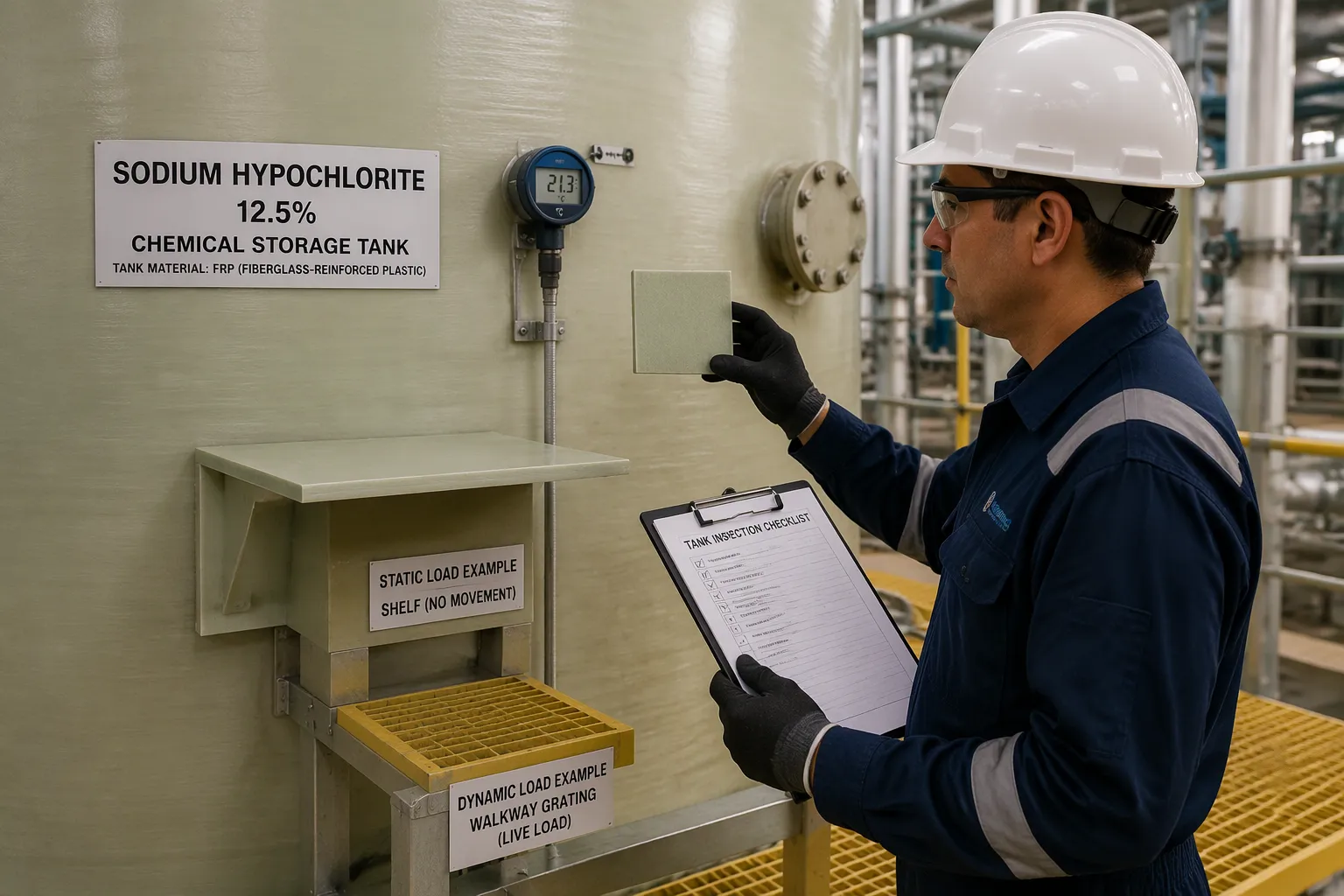
A buyer should begin with the service environment. Four questions cover most of the risk.
Identify the stored chemical. Name the exact substance, not a general label like acid or wastewater. Record its makeup, density, contaminants, and how long it will be stored.
Check the concentration. A resin that handles a diluted solution may fail at a higher concentration. Evaporation, mixing, and process interruptions can raise concentration over time.
Review the operating temperature. Heat makes a chemical more aggressive and weakens mechanical performance. Report both the normal operating temperature and the highest temperature reached during cleaning or transfer.
Evaluate mixed chemicals. A mixture can act differently from each component alone. Even a small amount of solvent or oxidizing agent can change compatibility.
Orthophthalic polyester is an economical resin generally used for water, non-corrosive liquids, and light duty applications. Its resistance to aggressive chemicals and elevated temperatures is limited, so it is generally not the first choice for demanding chemical storage.
Load questions come next. A static load such as a shelf or a basin differs from a dynamic load such as a walkway under foot traffic. Structural parts need a higher safety margin than cosmetic panels. Exposure duration closes the loop. A short-term indoor part and a long-term outdoor part follow different rules, and long outdoor service calls for UV inhibitors in the resin system.
Code, Compliance, and Budget
Fire performance often decides the grade. Type CFR-25 is an orthophthalic polyester resin with a flame spread rating of 25 or less, which meets Class 1 per ASTM E84. Type O-AN matches CFR-25 but carries no fire retardant. Standard orthophthalic polyester is the least fire-resistant option in the family, so a project that needs a Class A rating should confirm the specific grade rather than assume it. A flame spread index of 25 or below is the Class A target, and the smoke developed index must stay under 450. Many FRP walkway specifications also ask for UL94 V-0 and self-extinguishing behavior per ASTM D635.
Budget checks should weigh savings against risk. The cost gap between grades is real, yet a part that fails early erases that saving through replacement and downtime. A buyer who confirms mild service conditions can specify orthophthalic resin with confidence and keep the budget intact.
Sourcing notes belong in the same review. Store sealed containers in a dry, well-ventilated area below 25°C, away from sunlight and heat. Shelf life runs a few months under those conditions and shortens at higher temperatures. Plan shipments in 220KG iron drums or 1000KG IBC tanks so storage space and handling equipment are ready on arrival.
Orthophthalic Resin vs. Isophthalic vs. Vinyl Ester
Performance and Application Fit
Each grade is made for a different kind of job. Isophthalic polyester gives better water resistance and strength. Marine industries now choose it for hulls and wet service. Orthophthalic polyester is still the standard low-cost resin for general work. Vinyl ester handles extreme corrosion and high heat. DCPD-modified resin sits in the middle. Its dicyclopentadiene backbone carries a high reactive-diluent load while staying very thin. That gives fast wet-out, low cure shrinkage, a clean surface finish, and lower styrene emission. Its heat and chemical resistance are lower than isophthalic, so it fits large moldings, body panels, and mass production where easy processing matters most.
A heavy-duty grating or marine-grade pultrusion job goes beyond orthophthalic. POLYMER's Corrosion Resistant Pultrusion Resin (PLM-106) shows that shift. This terephthalic grade resists seawater, acidic fumes, and alkaline solutions. It stops micro-cracking under heavy dynamic loads. Buyers pick it when a walkway or platform must last 20+ years in a corrosive site.
Cost Trade-Offs and Best Fit
Price per kilogram favors polyester. Vinyl ester usually costs more. The table below sums up the cost picture.
Resin Grade | Cost Indicator |
|---|---|
Orthophthalic polyester | Cost-effective; selected when chemical exposure is mild |
Isophthalic polyester | Lowest upfront (polyester family) |
Vinyl ester | Moderately higher; typically costs more per kilogram |
Water resistance clearly separates the two polyester grades:
Orthophthalic polyester is the standard low-cost resin used by many people.
Isophthalic polyester is now the preferred material in marine industries, where its better water resistance is wanted.
Isophthalic is supposed to be stronger and takes in less water.
Best fit follows what the part will face. Indoor, non-corrosive, moderate-load parts fit orthophthalic resin. Marine and corrosive environments fit isophthalic. Extreme corrosion and high heat fit vinyl ester. Large moldings and fast-cycle production fit DCPD-modified. POLYMER supplies all grades, so the right choice depends on the job, not on one default.
Orthophthalic resin is a good choice for indoor jobs that are not corrosive and only carry moderate loads. A buyer should confirm those three conditions first. Then the checklist settles the rest: the chemical list, the temperature range, the load type, and the fire rating. A specific limit crossing — water immersion, harsh chemicals, outdoor sunlight, or heavy dynamic stress — signals the moment to step up to isophthalic, DCPD-modified, or vinyl ester. Until then, the budget-friendly grade does the job well.
The next step is simple. Match the application profile to the right grade in POLYMER's Unsaturated Polyester Resin line. The technical team can review the service conditions and confirm the fit.
FAQ
How does a buyer confirm a job fits orthophthalic resin?
Check three things. The part stays indoors, avoids chemical contact, and carries moderate loads. A buyer who confirms all three can specify the grade with confidence. If any one condition fails, the job needs a higher grade.
What happens when an orthophthalic part sees direct sunlight?
The surface breaks down over time. The resin has limited UV stability. A gel coat or topcoat protects the part when sunlight is a factor. Without that barrier, outdoor service shortens the part's life.
Does orthophthalic resin meet common fire codes?
Standard grades offer the least fire resistance in the family. Molded grating in this grade meets a Class 1 flame spread rating of 25 or less per ASTM E-84. A project that needs a Class A rating should confirm the specific grade first.
How should a buyer store orthophthalic resin?
Store sealed containers in a dry, well-ventilated area below 25°C, away from sunlight and heat. Shelf life runs a few months under those conditions. Plan shipments in 220KG iron drums or 1000KG IBC tanks so handling equipment is ready.
When does a job need a higher grade?
Four signals mark the upgrade point: continuous water immersion, harsh chemicals, long outdoor sunlight exposure, or heavy dynamic stress. Each one crosses a limit of the orthophthalic envelope. Isophthalic, DCPD-modified, or vinyl ester then becomes the right choice.