





Why DCPD Resin Reduces Warping in Large Molds
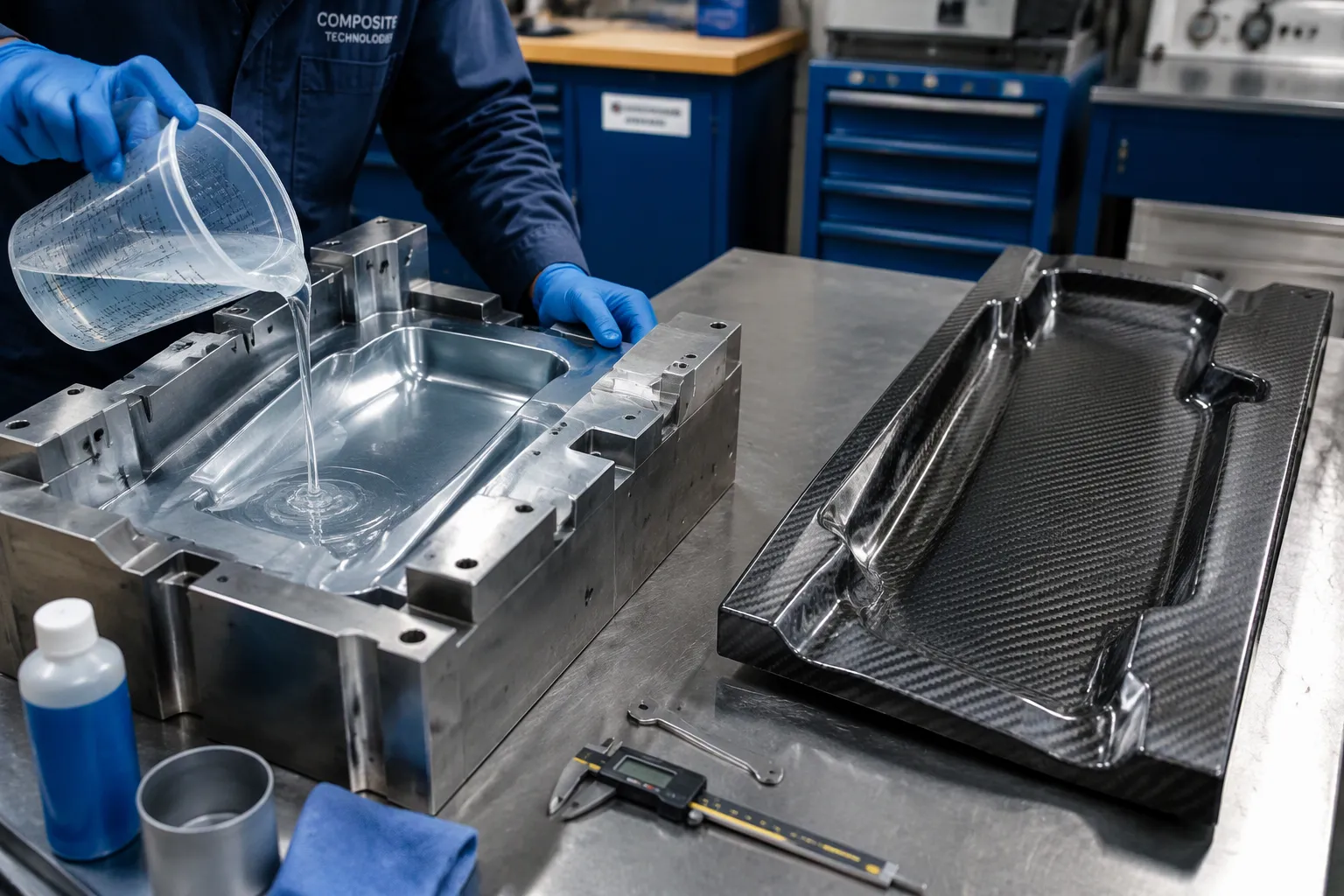
DCPD resin reduces warping in large molds in three ways: low polymerization shrinkage, a slow and even exotherm, and strong dimensional stability. Dicyclopentadiene causes this behavior. Poly-dcpd networks shrink little as they crosslink, and dcpd spreads reaction heat gently through thick sections. Dicyclopentadiene also lowers peak exotherm, which limits internal stress. Typical DCPD-modified UPR shows 7–9% polymerization shrinkage, compared with 8–11% for standard rigid orthophthalic UPR.
Large molds make every thermal and dimensional effect stronger, so fabricators struggle with deformation, cracks, and rework. Low shrinkage stops warping before it starts. This dcpd polyester resin discussion covers the causes, the mechanisms, resin comparisons, and practical guidance.
Key Takeaways
DCPD resin shrinks less than standard resins, which stops warping before it starts.
DCPD resin spreads heat evenly during cure, which reduces stress in thick sections.
DCPD resin holds its shape under load, which keeps large molds accurate.
DCPD resin costs more upfront but saves money through longer mold life and fewer defects.
Good design and proper storage help DCPD resin deliver its full low-shrinkage benefit.
What Causes Warping in Large Molds
Large molds make every shrinkage and heat effect stronger. Their volume-to-surface ratio slows heat transfer through the mass. A thick section sits far from any cooling surface, so it releases heat slowly. Small parts hide these effects; large parts reveal them.
Shrinkage During Cure
Cure shrinkage is the main cause. Thermosetting polymers harden through cross-linking, and each cross-linking event cuts volume. The part pulls inward as it cures. The resin cannot flow back once it gels, so the shrinking turns into stress. Post-cure adds more movement when parts sit unrestrained. A large mold holds more material, so total shrinkage grows and gets harder to control. Shrinkage during curing therefore sets the baseline for later distortion.
Thermal Gradients and Uneven Cure
Uneven exotherm creates temperature gradients. Thick sections hold heat longer than thin sections, so they cure later and shrink differently. Hot spots near thick bosses and cold spots near cooling lines widen the gap. Industry guidelines say the core-to-cavity temperature difference should not exceed 5°C to avoid uneven shrinking and later warpage. Large tools struggle to hold that limit in areas far from cooling channels.
Secondary factors make the problem worse. High-viscosity resins trap air, and voids create local weak zones. Fillers such as talc, glass fiber, glass beads, and wood flour reduce shrink, yet uneven filler distribution creates differential contraction. Improper mold storage also deforms the tool itself. Air pockets lower local strength and give shrinkage a place to concentrate. The tool then passes its own distortion into every part it shapes.
DCPD changes this picture. Dicyclopentadiene builds a poly-dcpd network that shrinks less. This dicyclopentadiene structure also shows a low exotherm, so heat spreads gently. The dicyclopentadiene ring limits internal stress in thick sections. A dcpd polyester resin still faces expansion and contraction cycles, yet its low shrinkage keeps cracking and warping issues rare during molding. DCPD resin, DCPD chemistry, and DCPD-modified systems all reduce the driving forces described above, and dicyclopentadiene content sets their baseline.
How DCPD Resin Counters Shrinkage and Warping
Low Shrinkage and Even Cure
Every cause from the last section has a DCPD property that answers it. Cure shrinkage is met by low polymerization shrinkage. Thermal gradients are met by a slow and even exotherm. Air entrapment and filler drift are met by controllable thickening. Service stress is met by high mechanical strength. DCPD resin answers the whole list, not just one item on it.
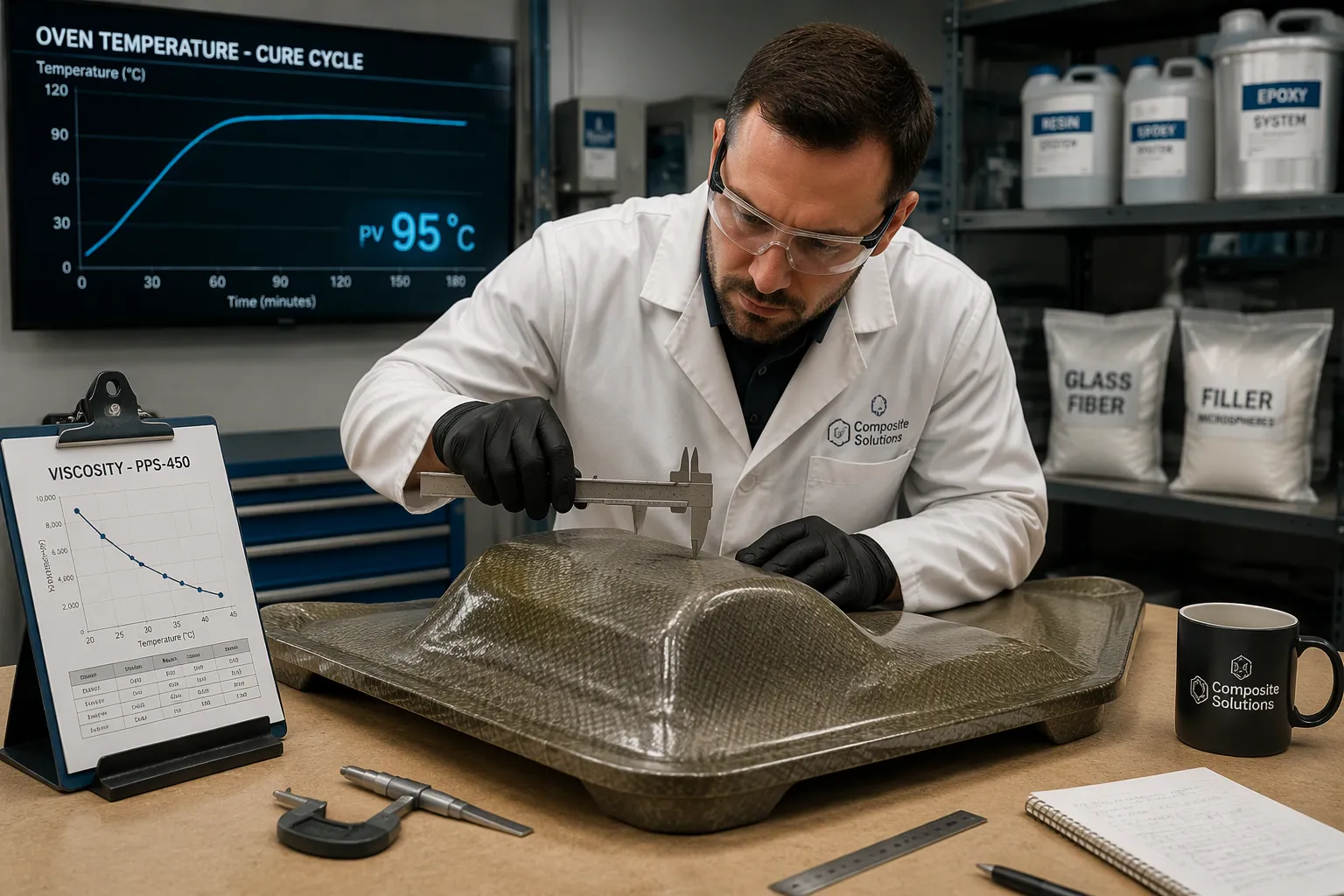
Dicyclopentadiene builds a poly-dcpd network that crosslinks with very little volume loss. The ring structure packs tightly, so the resin pulls inward much less as it gels. A dcpd polyester resin therefore holds its shape from the moment it sets. Low shrinkage means fewer stress cracks in thick sections, and the part needs less rework after demolding. The low exotherm of dicyclopentadiene spreads reaction heat through the mass. Thick bosses and thin ribs then cure closer together in time, which narrows the temperature gap that drives uneven contraction.
Controllable thickening gives fabricators a second lever. A dcpd modified resin can build viscosity on a predictable schedule, so the mix holds fiber and filler in place before gel. Uniform filler distribution removes the differential contraction that talc, glass beads, and wood flour can cause when they settle. The low water absorption rate of a dicyclopentadiene polyester resin also limits moisture-driven movement in humid shops. Together these traits give DCPD its low-shrinkage benefit across the whole cure cycle.
Dimensional Stability in Large Molds
Dimensional stability under load decides whether a big tool keeps its tolerance. A dcpd polyester resin combines stiffness with toughness, so the part resists deflection when clamps, fixtures, or service pressure push on it. Low shrinkage prevents warping at the source, and the cured network stays put under sustained stress. Resistance to cracking under pressure follows from the same structure. The poly-dcpd backbone absorbs strain instead of transferring it to a brittle matrix, which keeps large molds serviceable through repeated cycles.
The mechanical data support this claim. Unreinforced DCPD-modified resin reaches 80–120 MPa flexural strength and 3.0–4.5 GPa flexural modulus, with tensile strength at 50–80 MPa and notched Izod impact at 30–60 J/m. Fiber reinforcement lifts flexural strength to 250–450 MPa at 30–50 wt% fiber and flexural modulus to 12–25 GPa. Hardness sits at 35–50 Barcol. These values give a dcpd modified unsaturated polyester resin the stiffness a large mold needs without the brittleness that invites cracking.
Long-term aging matters as much as initial numbers. The chart below tracks Barcol hardness, flexural strength, and flexural modulus over time.
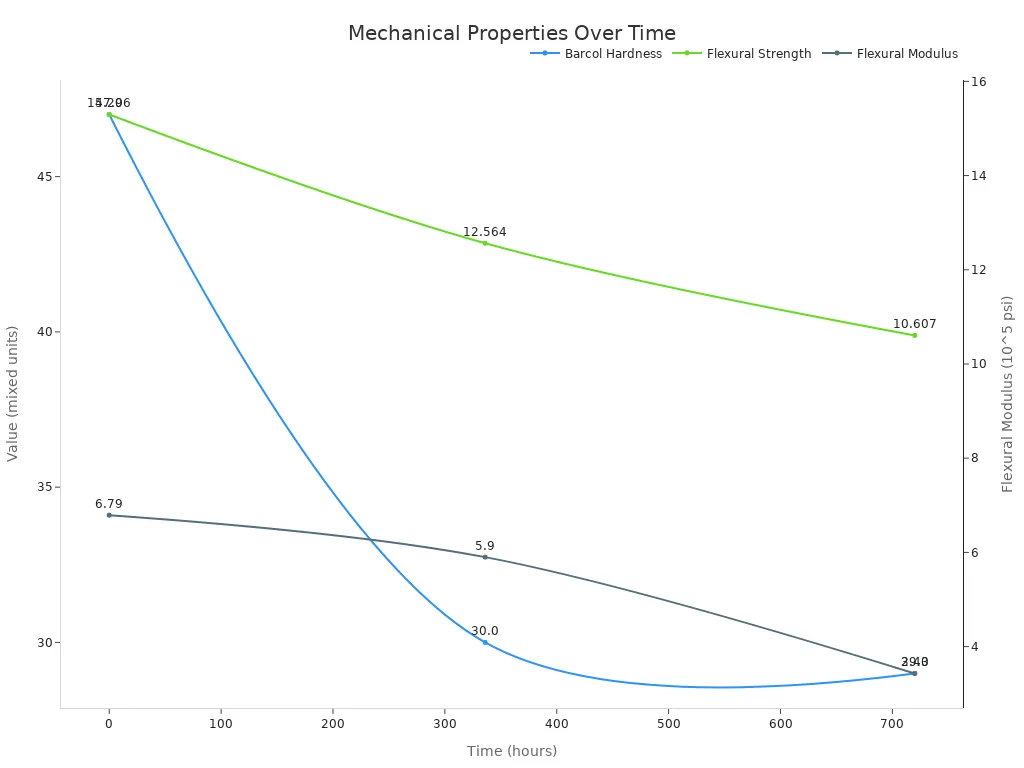
Hardness falls from 47 to 30 after 336 hours and settles near 29 at 720 hours. Flexural strength drops from 105.46 to 86.62 thousand kPa at 336 hours and to 73.13 thousand kPa at 720 hours. Flexural modulus moves from 46.8 to 40.7 and then to 23.6 hundred thousand kPa. The decline is gradual, so a dcpd resin keeps useful stiffness through a long service life.
POLYMER's DCPD-modified Unsaturated Polyester Resin is one concrete example of this formulation. The company supplies it as an unsaturated polyester resin in 220KG drums or 1000KG IBC tanks, with customizable grades for different line speeds. A dicyclopentadiene polyester resin from this range gives mold builders a practical starting point for large molds that demand tight tolerances.
DCPD Resin vs. Other Resins for Large Molds
Performance and Application Fit
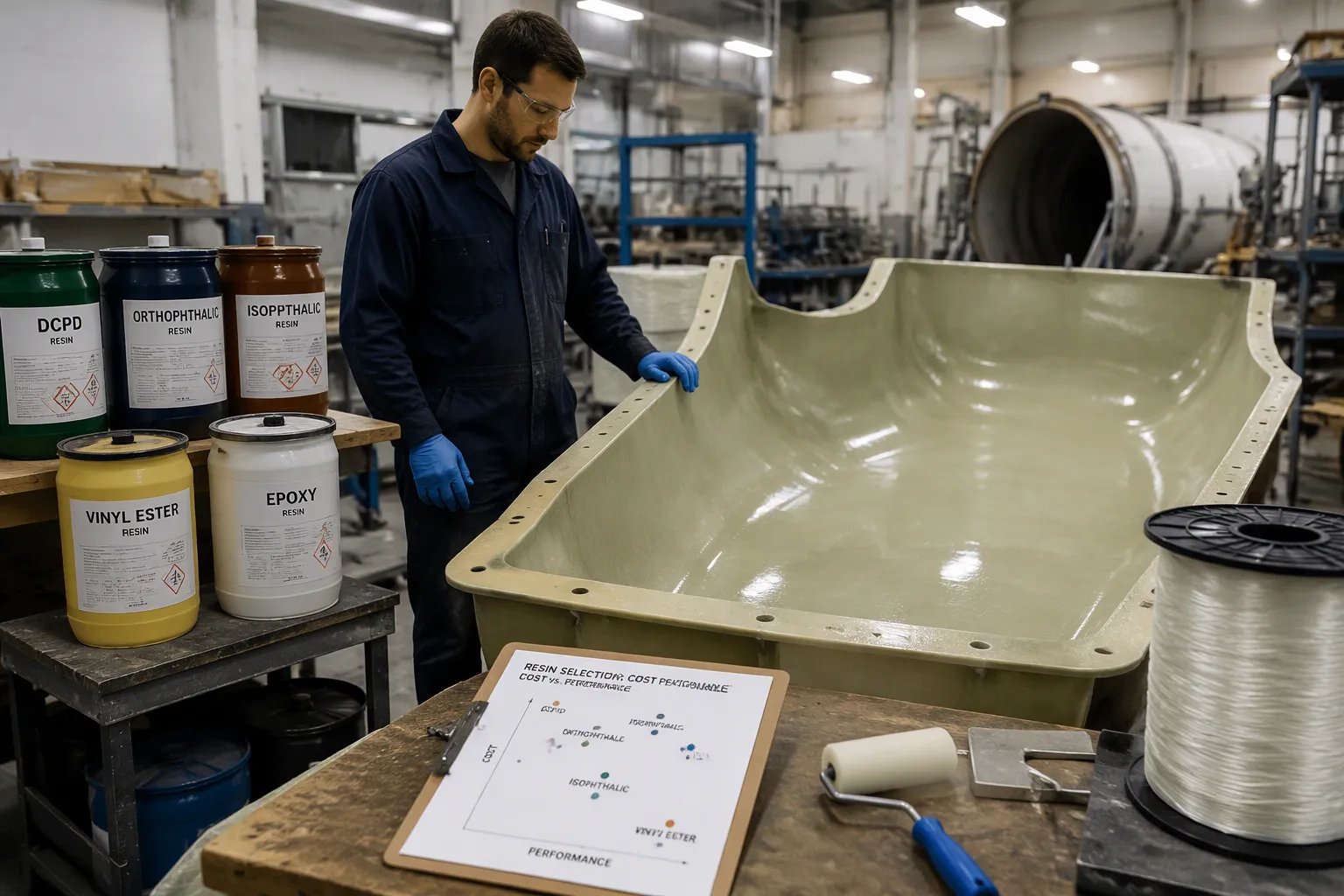
Each resin family does a different job in large-mold work. Orthophthalic unsaturated polyester resin gives good mechanical properties and chemical resistance at the lowest cost. That makes it a good fit for general-purpose parts and medium mold sizes. Isophthalic resin costs more, but it returns better chemical and corrosion resistance with higher durability. It fits tanks, marine parts, and corrosive service. Vinyl ester and epoxy sit at the high end for chemical and thermal demand. A dcpd modified unsaturated polyester resin sits in the middle. Dicyclopentadiene raises heat distortion resistance, improves hydrolytic stability, and adds toughness beyond general-purpose grades.
Resin Type | Cost | Performance |
|---|---|---|
Orthophthalic | Cost-effective; most prevalent | Good mechanical properties and chemical resistance |
Isophthalic | Higher cost premium | Enhanced chemical and corrosion resistance; higher durability |
DCPD | Premium prices | Higher heat distortion resistance, better hydrolytic stability, increased toughness |
A dcpd polyester resin earns its place where low shrinkage matters most. Large molds and thick parts reward that trait. Dcpd uprs also run a lower exotherm than unmodified unsaturated polyesters. The dicyclopentadiene structure gives a dcpd modified resin its edge in thick sections, and dicyclopentadiene also lowers peak heat release. A dcpd modified polyester still processes on familiar hand lay-up and filament winding lines, so shops avoid a full process change. Where chemical attack dominates, vinyl ester and epoxy remain the natural pick. Where cost rules, orthophthalic stays the practical choice.
Compliance and Cost
Upfront price tells only part of the story. A high-performance unsaturated polyester resin costs more per pound than general-purpose UPR, yet it delivers longer mold life and fewer defects. That combination lowers total cost per part over the run. General-purpose UPR keeps a lower price per pound and a baseline defect rate, so it can carry a higher total cost in long production. A dcpd polyester resin sits in the premium tier because of higher raw material costs and complex synthesis.
Resin Type | Upfront Cost | Mold Durability | Defect Rate | Lifecycle Outcome |
|---|---|---|---|---|
High-performance UPR | Higher per pound | Longer life | Fewer defects | Lower total cost per part |
General-purpose UPR | Lower per pound | Baseline | Baseline | Higher total cost possible |
Compliance supports the choice. POLYMER holds ISO/CE certification and offers customizable formulations for different line speeds. The company supplies its unsaturated polyester resin in 220KG drums or 1000KG IBC tanks as a one-stop source. A dcpd resin from that range gives mold builders a compliant option with low shrinkage. The poly-dcpd network also limits warping in service, and a poly-dcpd backbone keeps shrinkage predictable batch to batch. A dicyclopentadiene polyester resin also resists moisture pickup in humid shops. The dicyclopentadiene ring packs tightly, so tolerances hold through repeated cycles. Buyers weighing a dcpd unsaturated polyester against other grades should match the resin to the duty cycle, not to the price tag alone.
Best Practices for Low-Shrinkage Large Molds
Mold Design and Process Control
Good design gives a low-shrinkage resin room to work. A dcpd polyester resin still needs sound geometry, so builders should follow a few rules.
Put gates at the heaviest cross-section and away from cores and pins. Make the flow path shorter to avoid marks on the surface.
Keep wall thickness within 10 percent along the full length. Make any change in thickness gradual.
Keep ribs and bosses at 50–70 percent of the nominal wall thickness. Hollow out heavy areas.
Use valve gates where you can. They create less shear, so warping goes down and physical properties get better.
Packing pressure and hold time make up for the shrinkage that remains. Removing air matters too, because trapped voids create weak spots where distortion starts. A dcpd modified system with a low exotherm cures more evenly under these conditions. Dicyclopentadiene limits peak heat, and dicyclopentadiene also keeps the flow front steady. The poly-dcpd network then sets with fewer internal defects. DCPD resin rewards a well-designed tool, and dcpd chemistry handles thick sections better than general-purpose grades.
Storage, Handling, and Post-Cure
Storage protects the tool and the resin. Keep unsaturated polyester resin below 25°C in a cool, dry, well-ventilated area. Avoid heavy loads and folded storage, which warp molds and pass that distortion into parts. Controlled post-cure limits more warping. Raise the temperature slowly, and hold parts in place where the design allows. Dicyclopentadiene reduces movement during this stage, and dcpd content keeps tolerances tight. A dcpd polyester resin also resists moisture pickup, so humidity in the shop causes less drift. DCPD molding benefits from these habits, and dicyclopentadiene gives the cured part its stability.
POLYMER supports these steps in practical ways.
Offering | Details |
|---|---|
Free samples and technical support | Contact POLYMER for free samples and technical support. |
Technical proposal | Get a technical proposal within 12 hours. |
Material selection guide | Submit the application and molding process; engineers provide a selection guide. |
Free test samples | Engineers dispatch free test samples rapidly. |
A dcpd unsaturated polyester resin paired with this support gives large molds a reliable path to low shrinkage.
Large molds reward the right chemistry. DCPD resin limits warping through low shrinkage, an even cure, and stable dimensions. Dicyclopentadiene builds a poly-dcpd network that pulls inward little. Dicyclopentadiene also spreads reaction heat gently. Shrinkage during cure and uneven exotherm drive most distortion, and a dcpd polyester resin answers both. A dcpd modified unsaturated polyester resin fits thick sections; orthophthalic, isophthalic, vinyl ester, and epoxy serve other niches. Dicyclopentadiene rewards sound design, packing pressure, cool storage, and post-cure. Low shrinkage stops warping before it starts. Dicyclopentadiene keeps tolerances tight, and the poly-dcpd backbone resists moisture drift. A dcpd polyester resin holds shape under load. Teams can contact POLYMER for unsaturated polyester resin selection and support.
FAQ
How much less does DCPD resin shrink than standard grades?
Typical DCPD-modified UPR shows 7–9% polymerization shrinkage. Standard rigid orthophthalic UPR shows 8–11%. That gap may look small on paper. But in a large mold, the difference adds up over the whole part. So a dcpd polyester resin holds tolerances that general-purpose grades find hard to match.
Why does dicyclopentadiene suit thick sections?
Dicyclopentadiene spreads reaction heat gently through the mass. Thick sections then cure closer in time to thin ones. Industry guidelines cap the core-to-cavity difference at 5°C. A dcpd modified system stays nearer that limit. The poly-dcpd network then sets with fewer internal stress points.
How should shops store DCPD-modified resin?
Keep unsaturated polyester resin below 25°C in a cool, dry, well-ventilated area. Avoid heavy loads and folded storage, which deform molds. Proper storage protects the low-shrinkage behavior that dicyclopentadiene provides.
When should a fabricator choose DCPD over other resins?
A dcpd polyester resin fits large molds and thick parts where low shrinkage matters most. Orthophthalic suits general-purpose work at lower cost. Isophthalic serves corrosive service. Vinyl ester and epoxy handle extreme chemical and thermal demand. Match the resin to the duty cycle.
Does post-cure add warping to DCPD parts?
Post-cure can add movement when parts sit unrestrained. Raise the temperature slowly and hold parts in place where the design allows. Dicyclopentadiene limits movement during this stage. The polydicyclopentadiene backbone keeps tolerances tight. Controlled post-cure protects the gains from low shrinkage.