




How to Compare CTI, Arc Resistance and Flame Ratings for SMC Resin for Electrical Enclosures

CTI measures tracking resistance. Arc resistance measures resistance to arc formation. Flame ratings show fire safety. Comparing these properties requires a clear grasp of definitions, test standards, and application relevance. Consider a technical buyer evaluating several SMC grades side by side. They may be unsure which property to prioritize for a circuit breaker housing or a control cabinet. These three ratings are often confused or treated interchangeably. This leads to suboptimal material selection. Arc resistance and flammability are distinct claims. Buyers who conflate them misjudge risk. This article provides a step-by-step comparison framework with parameter tables. These tables allow horizontal evaluation of SMC resin for electrical enclosures.
Key Takeaways
CTI, arc resistance, and flame ratings each check a different safety feature. Do not think of them as the same thing.
Figure out what your enclosure needs first. Then use one table to compare material grades against those needs.
Always ask suppliers for test reports. Check the test method, thickness, and pass rules for each rating.
A high score in one rating does not make up for a low score in another. Judge all three together.
Use the ratings as screening tools. Let design codes and end-product tests certify the final part.
CTI, Arc Resistance and Flame Ratings Defined
PTI and CTI: What Each Term Means
The comparative tracking index is the highest voltage, in volts, that a solid material can handle without forming a conductive track when conditions are dirty. IEC 60112 defines this index and gives the test method. Higher values mean better resistance to surface tracking and safer creepage distance design. Buyers often sort grades by PLC classification, which is a banded scale that groups materials by CTI range.
The proof tracking index works in a different way. PTI is a single-voltage pass/fail proof test. A material may pass PTI at 175 V, while its CTI determination shows it withstands voltages up to 300 V before failure. CTI comes from a stepwise search; PTI confirms one pre-set threshold. Datasheets show both because suppliers use PTI for batch acceptance and CTI for material characterization.
Dimension | PTI | CTI |
|---|---|---|
Core question | Does the part pass at one specified voltage? | What is the maximum voltage the material withstands? |
Output | Pass/fail at a single voltage | Maximum withstand voltage |
Typical use | Incoming QC, supplier verification | Material selection for new designs |
PTI checks whether a material passes at a single voltage set in advance. CTI searches for the highest voltage a material can pass.
Arc Resistance vs Flame Rating
Arc resistance measures how long a material survives a high-voltage, low-current arc near its surface under ASTM D495. The test tracks four failure modes: incandescent conduction, ignition, tracking lines, and surface carbonization. ASTM D495 serves preliminary screening and formulation-change detection, not specification limits.
Flammability ratings answer a different question. UL 94 V-0 allows afterflame of 10 seconds or less per flame application, with no burning drips that ignite cotton. The 5VA rating, the highest UL 94 class, forbids burn-through on the plaque. UL 746 covers long-term electrical performance, including CTI and arc resistance. A circuit breaker housing may need V-0, while an outdoor enclosure may demand 5VA. Buyers should compare both standards, plus the glow-wire flammability index where relevant, before selecting sheet molding compound grades.
How CTI and Arc Resistance Are Tested
Test Standards and Units
IEC 60112 sets the rules for the surface-tracking test behind every CTI claim. Two platinum electrodes sit 4.0 mm apart on the specimen, and a drop of contaminated solution falls every 30 seconds. The voltage goes up in 25 V steps from 100 V to 600 V. Five specimens must survive 100 drops at one level, then 50 drops at the next. The 50-drop result becomes the CTI; the 100-drop result stays on record as a qualifier. Buyers reading a proof tracking index should know it confirms just one voltage, while the CTI shows the full stepwise search.
ASTM D495 defines the arc-resistance test. Each stage runs 60 seconds, and the stages continue until 420 seconds total. The result is the time to failure in seconds.
arc resistance, n—the total elapsed time in seconds from the start of this test procedure until failure occurs.
UL 746 ties both methods into one electrical-performance framework. A circuit breaker or switchgear enclosure often needs evidence from all three standards.
Reading an SMC Datasheet
A datasheet mixes units that look alike but mean different things. CTI shows up in volts with a PLC band; arc resistance shows up in seconds; flame rating shows up as a UL 94 class. Check the specimen thickness behind each CTI value, because thin plaques track sooner. Check whether the flame claim is V-0 or 5VA, and look for the glow-wire flammability index test result, often 960 °C.
For smc resin for electrical enclosures, the electrical block should also list surface resistivity, often 10¹² Ω, and water absorption below 0.5 percent. These values shape insulation coordination. CTI, creepage distance, and arc resistance affect each other: a higher CTI allows shorter creepage distance at the same voltage class. Judge the trio together, never alone. A strong arc resistance number cannot make up for a low CTI, and a V-0 rating says nothing about tracking.
Comparing Values for SMC Resin for Electrical Enclosures

SMC vs BMC vs DMC: Rating Differences
A side-by-side technical parameter comparison shows where each molding compound earns its place. The table below gathers typical values for smc, bmc, and dmc, with GPO-3 laminate as a reference point.
Property | SMC | BMC | DMC | GPO-3 Laminate |
|---|---|---|---|---|
PTI (typical grade) | ≥ 600 V | ≥ 600 V | ≥ 600 V | Not typically quoted |
CTI material group | Group I (≥ 600 V) | Group I (≥ 600 V) | Group I (≥ 600 V) | Varies by grade |
Arc resistance | Not separately quoted in common data | Up to about 190 s | Up to about 190 s | Moderate |
UL 94 rating | HB, V-0, 5VA | HB, V-0, 5VA | HB, V-0, 5VA | Varies |
High-quality DMC insulating materials typically reach cti 600v, placing them in Material Group I, the highest class. BMC and DMC share chemistry, so both reach roughly 190 seconds of arc resistance, an outstanding figure among molding compounds. That endurance suits circuit breaker insulation parts, insulators, and meter housings. SMC datasheets rarely quote arc seconds, so buyers should request the ASTM D495 report directly.
This is where 珀勒玛 (POLYMER) SMC & BMC Compounds fit the comparison. Their sheet molding compound delivers cti 600v and above, ul 94 v-0 flame retardancy, dielectric strength of at least 20 KV/mm, and low shrinkage of 0.15 percent or less. Model PLM-6001 serves meter boxes and distribution cabinets, and the same platform covers circuit breaker insulation parts.
Flame Rating Classifications Compared
Flame retardancy claims need careful reading. UL 94 V-0 permits afterflame of 10 seconds or less per application, with no flaming drips and no burn-through. The 5VA test applies a flame roughly five times more severe and allows up to 60 seconds, still with zero burn-through. A ul 94 v-0 rated compound therefore passes a small-flame bench test, not a real-fire scenario.
V-0 is a relative, small-flame classification measured on a small bar in still air. It does not measure heat release, smoke, toxic gas, or how a finished assembly behaves in a developed fire.
Three limits matter for enclosure safety. The rating ties to the exact thickness tested, so a V-0 at 3.0 mm may fall to V-1 at 1.5 mm. The test says nothing about glow-wire flammability index performance, which some switchgear standards require. Flame retardancy also does not predict tracking behavior; a V-0 compound can still fail under surface contamination. Buyers should pair the flammability claim with cti and arc data, then confirm the glow-wire flammability index where the application demands it. Used this way, retardancy ratings screen materials, and design codes certify the finished part.
Building a Selection Framework for Buyers
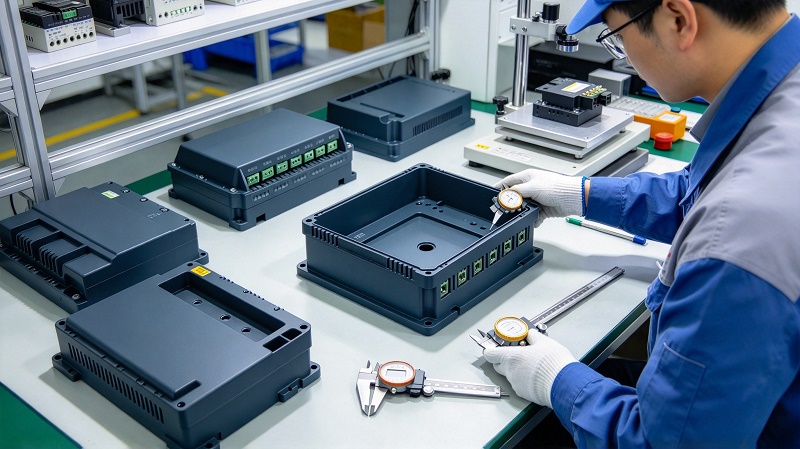
Prioritizing Ratings by Enclosure Requirement
A clear comparison stops the buyer from chasing the wrong number. The steps below go from what the application needs to data you can check.
Pin down the tracking requirement. Decide if the spec calls for CTI or PTI. Confirm the test standard, voltage, specimen count, and pass criteria. A PTI 600 result is not the same as a CTI 600 V claim.
Look at arc resistance. Ask how many seconds the surface lasts under a high-voltage, low-current arc. This matters for switchgear, circuit breaker housings, and parts near switching contacts.
Confirm flame retardancy. Ask for a standard, a class, and a tested thickness. Check third-party certification and any halogen-free or smoke limits.
Send in full application data. Give the voltage class, indoor or outdoor use, wall thickness, inserts, and yearly demand.
The table below lets a buyer score each grade against the same requirements.
Property | Example Grade Value |
|---|---|
Material | Sheet Molding Compound (electrical insulation grade) |
Glass fiber content | 25% |
Density | 1.8 g/cm³ |
Flexural strength | 170 MPa |
Heat Deflection Temperature | ≥200°C |
Dielectric strength | ≥12 kV/mm |
Comparative Tracking Index (CTI) | ≥600 V |
Arc resistance | ≥180 seconds |
Flame classification | To be confirmed from test report |
A grade that reaches cti 600v works well for high-pollution, high-voltage cabinets. 珀勒玛 (POLYMER) SMC & BMC Compounds offer custom formulas, technical support, and free test samples for this evaluation.
Common Comparison Mistakes
Buyers make the same mistakes when they compare smc resin for electrical enclosures. They treat CTI and PTI as the same thing. They compare values from different test methods, thicknesses, or conditioning. They assume every flame-retardant grade holds the exact certification the part needs. They pick by dielectric strength alone. They also use one grade for every part, though a meter box and a circuit breaker housing need different priorities.
Tracking and arc damage are two different failure modes. Tracking builds a carbon trail slowly, pulse by pulse. Arc damage pits the surface in milliseconds. The two make each other worse: a tracking trail can end in flashover, and an arc pit traps dirt that speeds up more tracking. A cti 600v figure grades tracking resistance only. It does not cover arc performance.
Three more traps deserve attention. Ignoring PLC classification hides where a grade sits on the banded scale. Comparing CTI without checking test thickness overstates thin-wall performance. Overlooking creepage distance breaks insulation coordination, because a higher CTI allows shorter spacing at the same voltage class. Flame retardancy claims also need a close look: a ul 94 v-0 rated compound passes a small-flame bar test, not a real-fire scenario. Pair that claim with arc data, confirm ul 94 v-0 flame retardancy at the stated thickness, and plan end-product glow-wire testing where switchgear standards require it. Treat retardancy ratings as screening tools, and let design codes certify the finished part. Used this way, the three ratings answer three different questions, and the smc grade that wins is the one that fits the application, not the one with the boldest single number.
Each rating answers a different question. CTI predicts tracking resistance when the surface is dirty. Arc resistance shows how well the material handles long arcs. Flame retardancy confirms fire safety. A circuit breaker housing and an outdoor cabinet need these answers in different amounts.
Buyers should define what the application needs first. Then they compare CTI, arc resistance, and flammability values against those needs in one parameter table. This method quickly shows which grades are weak.
Procurement teams should ask every SMC supplier for datasheets and test reports, including 珀勒玛 (POLYMER). Confirm each ul 94 v-0 rated claim at the thickness that was tested. Compare smc grades side by side, and let the application pick the winner.
FAQ
Which rating matters most for a high-voltage enclosure?
No single rating wins. CTI controls tracking when the surface is dirty, and it sets creepage distance. Arc resistance matters near switching contacts. Flame rating covers fire safety. Procurement teams should rank the three against the voltage class, pollution level, and indoor or outdoor placement of the enclosure.
How do SMC and BMC grades differ in arc performance?
BMC and DMC grades often quote arc resistance near 190 seconds under ASTM D495. SMC datasheets rarely list arc seconds, so buyers should ask for the test report directly. Both material families can reach CTI above 600 V, which puts them in the top material group.
Does a V-0 flame rating prove an enclosure is fire safe?
No. UL 94 V-0 is a small-flame bench classification tied to a tested thickness. It does not measure heat release, smoke, or toxic gas. The 5VA class uses a more severe flame. Buyers should pair the flame claim with CTI and arc data, then confirm glow-wire performance where standards require it.
Why do suppliers list both PTI and CTI?
PTI is a single-voltage pass/fail proof test. CTI comes from a stepwise search for the highest withstand voltage. Suppliers use PTI for batch acceptance and CTI for material characterization. A PTI pass at one voltage does not equal a CTI claim at the same value.
What should a buyer request before approving a grade?
Ask for the CTI test report with specimen thickness, the ASTM D495 arc data, and the UL 94 class at the stated wall thickness. Confirm the circuit breaker housing and cabinet requirements separately. Compare every smc grade against one parameter table, and request free samples for validation.