




How to Select High-Strength BMC Resins for Structural Parts
The discussion goes through each criterion in order and ends with a practical checklist readers can use right away. A formulation partner who tailors resin composition, rather than just picking from a catalog, often makes the difference between meeting structural performance targets and over-engineering the part. The right bmc grade gives the needed strength without excess.
Key Takeaways
First, define the load cases, safety factors, and failure modes to set clear material requirements.
Compare flexural, tensile, and impact strength using the same test standards so the evaluation is fair.
Match environmental resistance to the actual conditions the part will face, such as moisture, temperature, and chemicals.
Check that it meets UL94 V-0, RoHS, and REACH rules, and ask for test reports for the exact grade.
Think about the total cost of owning the part, not just the price per kilogram. This helps you avoid over-engineering.
Define Structural Requirements for BMC Resin
Loads, Safety Factors, and Failure Modes
Part design comes first. Engineers turn drawings and service conditions into load cases before they compare any bulk molding compound. They list the forces a part will face: static loads, repeated loads, impact events, and torque from fasteners. Each load case gets a safety factor. This factor shows how bad failure would be and how sure the load estimate is. A bracket that holds a safety guard needs a higher factor than a cosmetic cover.
Expected failure modes guide the rest. A part may crack, bend too far, or lose stiffness over time. The team writes down which mode matters most. That choice sets the mechanical strength requirements for the bmc material. A part that must not bend needs high stiffness. A part that takes impact needs toughness. This step also stops over-engineering. A designer who skips it may ask for the strongest grade on the market and pay for performance the part never uses.
Environment and Service Life
Service conditions drive selection as much as loads do. Moisture exposure matters. A part near a washdown station or outdoors sees water, and some resins soak it up. Temperature cycling matters too. Repeated heating and cooling can wear out a joint or a molded insert. Chemical contact is a third driver. Oils, fuels, cleaning agents, and road salts each harm different resin chemistries. Mechanical stress completes the picture. A part under constant load may creep, and the bmc resin must resist that creep for the full service life.
Writing down these conditions stops under-specifying. A team that ignores salt spray may pass lab tests and fail in the field. A team that ignores creep may see a structural part sag after months of load. Clear requirements keep every material route on equal footing. They let the team judge each bmc option against the same facts.
Compare Mechanical Properties and Fiberglass Reinforcement
Flexural, Tensile, and Impact Strength
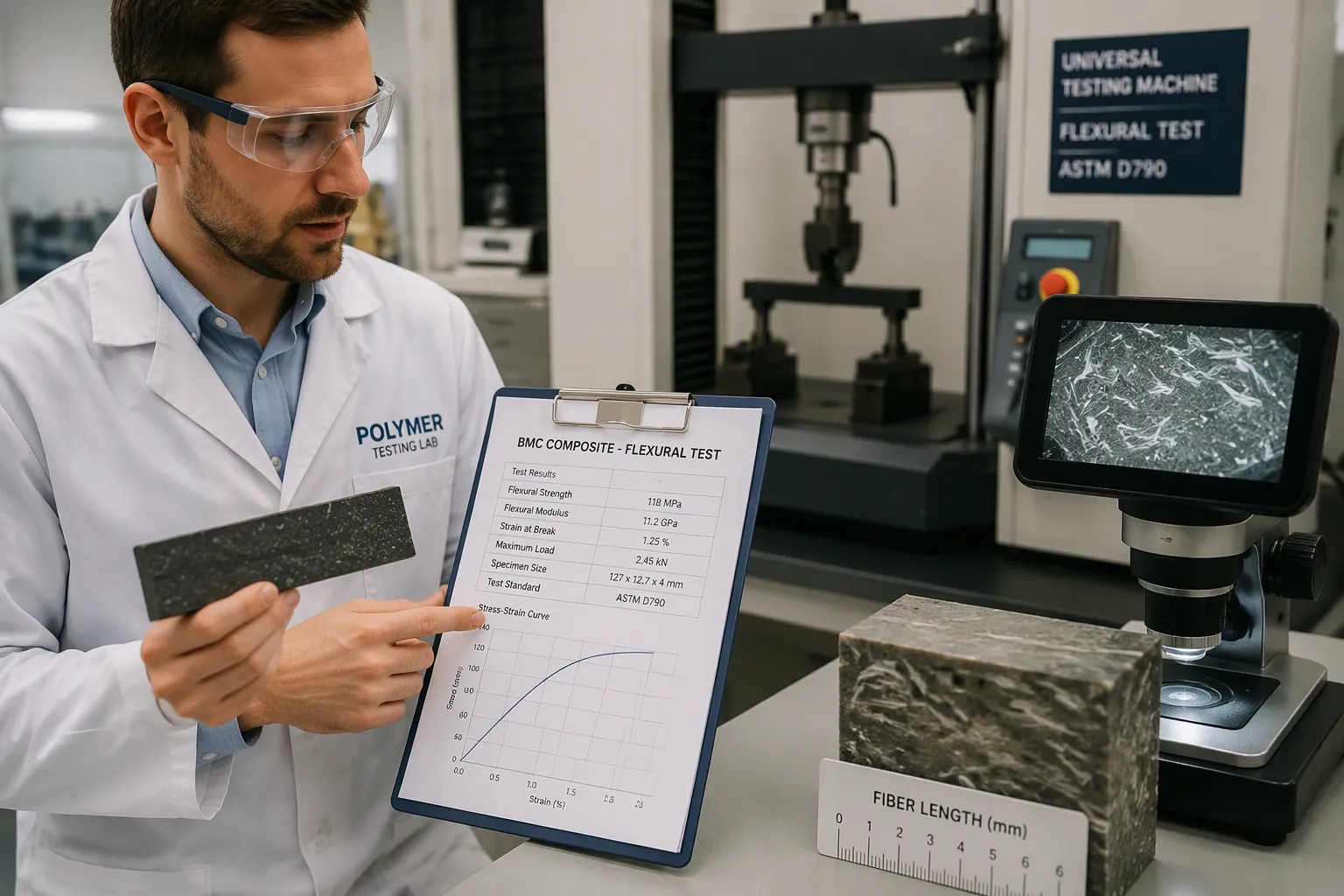
Read datasheets with care. Flexural strength shows how a part resists bending before it cracks. Tensile strength shows how it resists pulling apart. Impact strength shows how much sudden energy it absorbs without breaking. Each value comes from a specific test method, so readers should compare numbers made under the same standard. A flexural figure from one lab means little next to a tensile figure from another. Test temperature and conditioning also change results, and dry samples often read stronger than conditioned ones.
Impact data needs extra care. A notched specimen and an unnotched specimen tell different stories. Structural parts that see dropped tools or road debris need the unnotched view. Teams should also check whether the datasheet reports average values or minimum values. Design work should rely on minimums, because averages hide weak batches.
BMC Resin Composition and Fiberglass Reinforcement
Composition drives performance. The matrix usually starts with unsaturated polyester resin, and vinyl ester or phenolic versions exist for tougher environments. Inorganic fillers make up 20–70 vol% of thermoset molding materials and shape mechanical properties, dimensional stability, and cost. Glass fibers carry the load. E-glass fibers at 10–30 wt% add 50–150 MPa of tensile strength and impact resistance to bulk molding compound formulations.
Fiberglass reinforcement level separates grades more than any other factor. Chopped glass fibers of 6.4 mm and 12.7 mm lengths are common, with content generally controlled between 50% and 55%. Higher fiber content raises strength and stiffness, yet too much fiber makes molding harder. Higher reinforcement content also brings higher tensile strength and better stiffness, which matters for lightweight structural components that replace metal. Fiber orientation adds another layer. Injection and transfer molding line up fibers and create anisotropic tensile strength, with longitudinal values 1.5–2.5 times the transverse direction. Compression molding yields more isotropic laminates because fibers stay randomly oriented.
SMC typically has a higher percentage of glass reinforcement and is stiffer, whereas BMC typically has higher mineral-filler loadings, making it less costly. Both use thermosetting matrices (unsaturated polyester and vinyl ester, with BMC also available in phenolic) reinforced with chopped glass and mineral fillers.
That trade-off explains why a bmc resin suits small, intricate parts while SMC serves large panels. A typical bmc grade runs about 30% lower in strength than SMC because of lower glass content and higher filler loading. Neither route is wrong; each fits its part.
POLYMER's SMC & BMC Compounds show what a tuned formulation can do. The line offers customizable hardness, color, and flowability. The Class A SMC line reaches flexural strength up to 240 MPa and density as low as 1.47 g/cm³, a high-strength fiberglass-reinforced composite material for structural applications. Flame retardancy meets UL94 V-0, and the comparative tracking index exceeds 600V where relevant. This is a high strength material with superior mechanical strength, and it supports compression strength targets in demanding parts. Buyers who need a polyester resin system with balanced mechanical properties can start there and adjust from a known baseline.
Assess Environmental Resistance of Fiberglass-Reinforced Molding Compounds
Chemical, Thermal, and Weathering Resistance
The place where a part is used decides which resistance claims really matter. A part near a chemical tank faces acids and alkalis. A coastal setup faces salt spray. An outdoor panel faces UV and temperature changes. Teams should match each datasheet claim to the real exposure, not to a general label. A resin that resists weak acid may still fail in a strong alkali. Fiberglass-reinforced molding compounds resist acids, alkalis, and salt spray well when the matrix is picked for that job. A vinyl ester or polyester resin base handles many harsh settings, while standard grades work for milder ones. Heat exposure needs the same care. Constant heat wears down a matrix, and repeated cycling stresses the bond between resin and glass fibers. UV exposure breaks down bare surfaces, so outdoor parts often need a gel coat or a UV-stable formulation.
Molding Behavior and Cycle Time
Processing fit decides whether a good formulation turns into a good part. Compression molding suits large, load-bearing shapes and gives more even fiber orientation. Injection molding fills small, complex, precision parts fast. Flowability, the thickening curve, and fiber content all affect cycle time. A bulk molding compound with high fiberglass reinforcement flows less freely and needs more pressure. BMC fits small, intricate parts, while SMC serves larger structural panels. The compression molding process rewards a matched thickening curve, because the compound must flow before it gels. Storage belongs in the same decision. Keep compounds cool at 25°C, dry, and wrapped in PE film to limit styrene loss. Shelf life runs 3–6 months, so teams should plan usage against that window. Fiberglass-reinforced composites reward buyers who confirm processing fit before they commit.
Verify Compliance and Weigh Cost-Performance
UL, RoHS, REACH, and Industry Standards
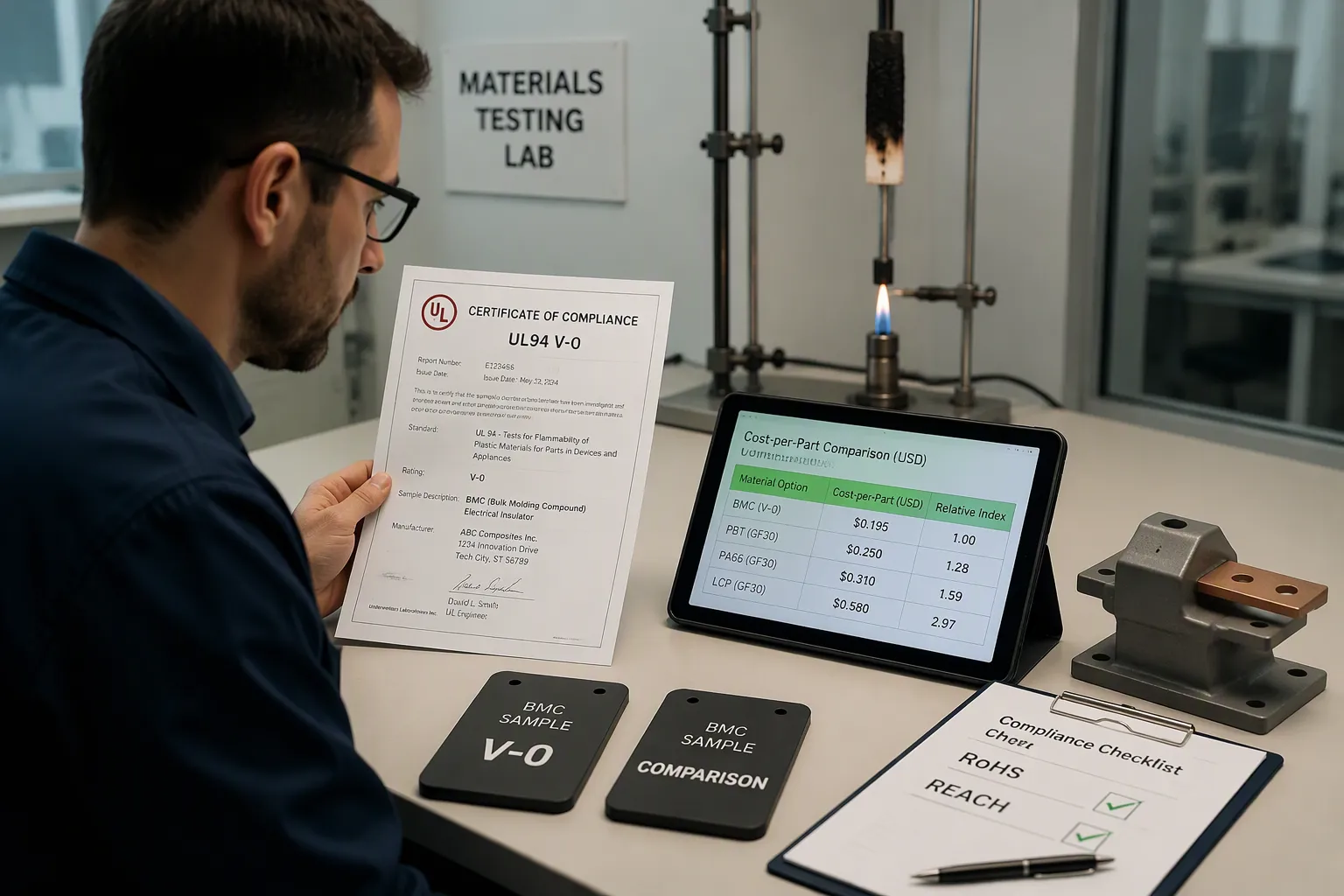
Compliance checks make sure a compound meets legal and safety rules before production starts. Teams should check UL94 V-0 for flame retardancy, RoHS for restricted substances, and REACH for chemical registration. Automotive and rail projects often add ISO/IATF requirements. Flame-retardant grades of bulk molding compound reach UL94 V-0 because the thermoset resin chars instead of melting. Mineral fillers release water vapor to cool the surface, and glass fiber forms a hard char layer. The table below shows how V-0 compares to other ratings.
Rating | Self-Extinguish Time | Flaming Drips | Typical Use Case |
|---|---|---|---|
HB | No requirement (slow horizontal burn) | Allowed | Low-risk, non-critical enclosures |
V-2 | ≤30 sec per specimen | Allowed (must not sustain burning) | Consumer housings |
V-1 | ≤30 sec per specimen | Not allowed | General electrical components |
V-0 | ≤10 sec per specimen | Not allowed | Busbar insulators, switchgear, high-voltage panels |
5VA / 5VB | ≤60 sec cumulative, larger flame exposure | Not allowed (5VA) / minor (5VB) | Thicker structural enclosures |
Buyers should ask the supplier for test reports and certificates directly. A documented V-0 rating on the exact grade counts more than a general claim on a brochure.
Total Cost Versus Over-Engineering
Material price alone hides the real cost picture. Total cost of ownership includes cycle time, scrap rate, secondary operations, and the cost of over-engineering. A part molded from a bmc resin with more filler may cost less per kilogram, but extra machining can erase that gain. The table below compares two case studies.
Cost Category | Case Study #1 – Aluminum | Case Study #1 – BMC | Case Study #2 – Aluminum | Case Study #2 – BMC |
|---|---|---|---|---|
Material Cost / Part | $0.14 | $0.19 | $0.133 | $0.08 |
Molding Cost / Part | $0.225 | $0.281 | $0.23 | $0.22 |
Secondary Gate Trimming | – | $0.01 | – | $0.01 |
Secondary Machining | – | $0.035 | – | $0.035 |
Scrap @ 3% | $0.011 | $0.015 | $0.011 | $0.001 |
Brush Plate (2nd Part) | – | – | – | $0.217 |
Total Cost / Part | $0.376 | $0.531 | $0.374 | $0.563 |
Savings | – | 30% | – | 34% |
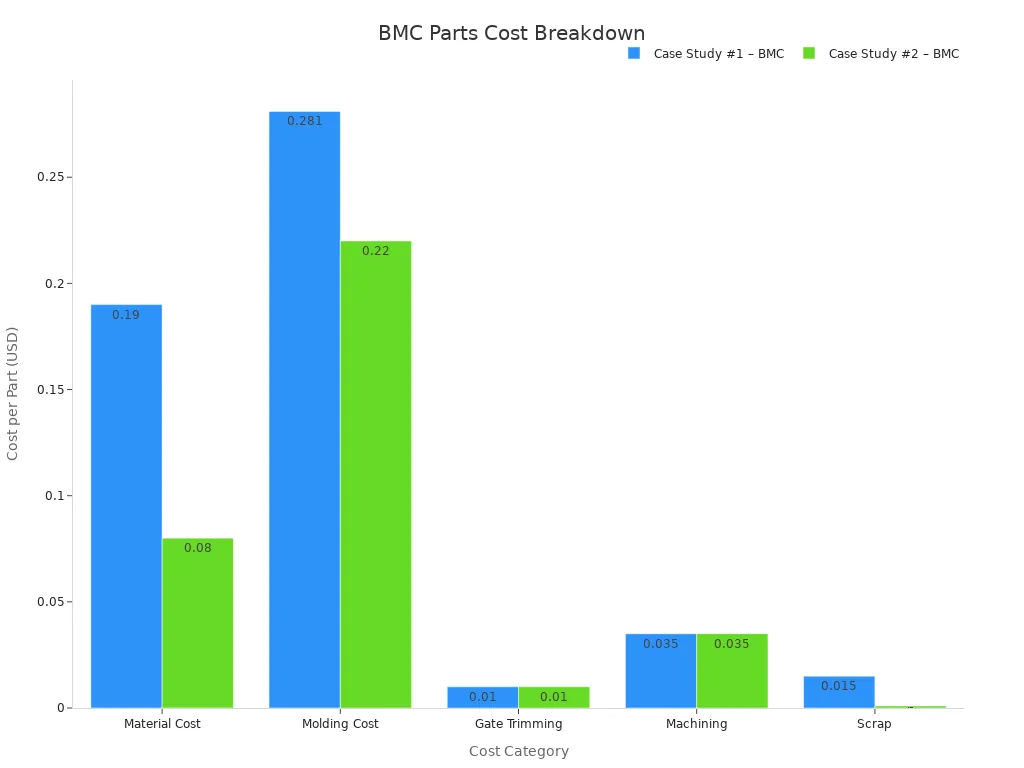
Each formulation type fits a different job. A bmc grade with high glass content suits structural parts that need strength. A grade with more mineral filler fits non-critical covers where cost matters most. The goal is the right resin for the part, not the highest-spec option on the shelf.
Apply a BMC Selection Checklist
Step-by-Step Decision Criteria
A written checklist helps you explain your choice later. Teams can go through six steps in order and write down the proof at each one.
Requirements defined: load cases, safety factors, and failure modes are written down.
Mechanical data compared: flexural, tensile, and impact values come from the same test standard.
Environment matched: chemical, thermal, and UV exposure claims fit the real service site.
Process confirmed: the molding method, flowability, and cycle time fit the part shape.
Compliance verified: UL94 V-0, RoHS, REACH, and ISO/IATF certificates are on file.
Cost weighed: total cost of ownership, not price per kilogram, picks the winner.
Each step builds on the one before it. A team that skips step one may compare datasheets that never applied to the part. A team that skips step six may pick a premium grade and pay for performance the design never needed.
When to Engage a Formulation Partner
Standard grades cover many jobs. A custom formulation makes sense when a part falls outside the usual range. Examples include a structural bracket that needs more stiffness than catalog data shows, a housing that faces a chemical no standard grade lists, or a thin wall that needs flow behavior the stock bmc material cannot deliver. At that point, picking from a catalog stops working.
POLYMER fits here as a formulation partner. The technical sales team reviews the application and the molding process, then sends a material selection guide. A technical proposal follows within 12 hours, and free test samples let the team check the choice before production. This support helps buyers tune fiberglass reinforcement levels, filler loading, and flow characteristics against their own tooling. The same team can adjust a bmc resin for a specific compression molding process or confirm that a grade suits injection molding instead.
The goal stays fixed: the right resin, not the highest-spec resin. A grade tuned to the part meets structural performance targets at a fair cost. A grade chosen for bragging rights adds weight, cost, and molding difficulty. Buyers who treat the checklist as a gate, and the formulation partner as a resource, reach the first outcome far more often. They also build a record that supports later audits and re-certification. For structural applications, that record matters as much as the part itself.
Selection follows a set order. Teams define requirements first, then compare mechanical and environmental performance, confirm processing fit, verify compliance, and weigh total cost. That sequence keeps every candidate on equal footing and protects the part's strength in real service.
The goal is the right resin, not the highest-spec resin. A written checklist keeps each decision defensible during audits and re-certification. Readers should bring a formulation partner in early, because tailored bmc chemistry often meets structural targets that catalog grades miss. Prototype testing then confirms the choice before full production. A tuned bmc grade, tested on real parts, delivers predictable performance at a fair cost.
FAQ
How strong is a high-strength bmc compared with SMC?
A typical bmc grade is about 30% weaker than SMC. Less glass content and more filler loading explain the gap. A well-tuned bmc formulation can still reach flexural strength up to 240 MPa. Small, detailed parts gain the most from this route.
Does a bmc part meet flame and electrical safety rules?
Flame-retardant grades reach UL94 V-0. The thermoset matrix chars instead of melting, and mineral fillers release water vapor to cool the surface. Electrical grades also deliver a comparative tracking index above 600V. Buyers should ask for test reports for the exact grade.
How should a team store bulk molding compound before use?
Store the compound at 25°C in a cool, dry place. Keep it wrapped in PE film to limit styrene loss. Shelf life runs 3–6 months, so teams should plan usage against that window. Poor storage changes flow behavior during compression molding.
When does a custom bmc formulation make sense?
Standard grades cover many jobs. A custom formulation fits parts outside the usual range, such as a bracket needing extra stiffness or a housing facing an unusual chemical. POLYMER reviews the application, sends a technical proposal within 12 hours, and supplies free test samples.
Does fiberglass content change molding behavior?
Yes. Higher fiberglass reinforcement raises strength and stiffness, yet it reduces flow. A compound with more glass needs more pressure during compression molding. Teams should confirm flowability and cycle time against their tooling before they commit to a bmc grade.